
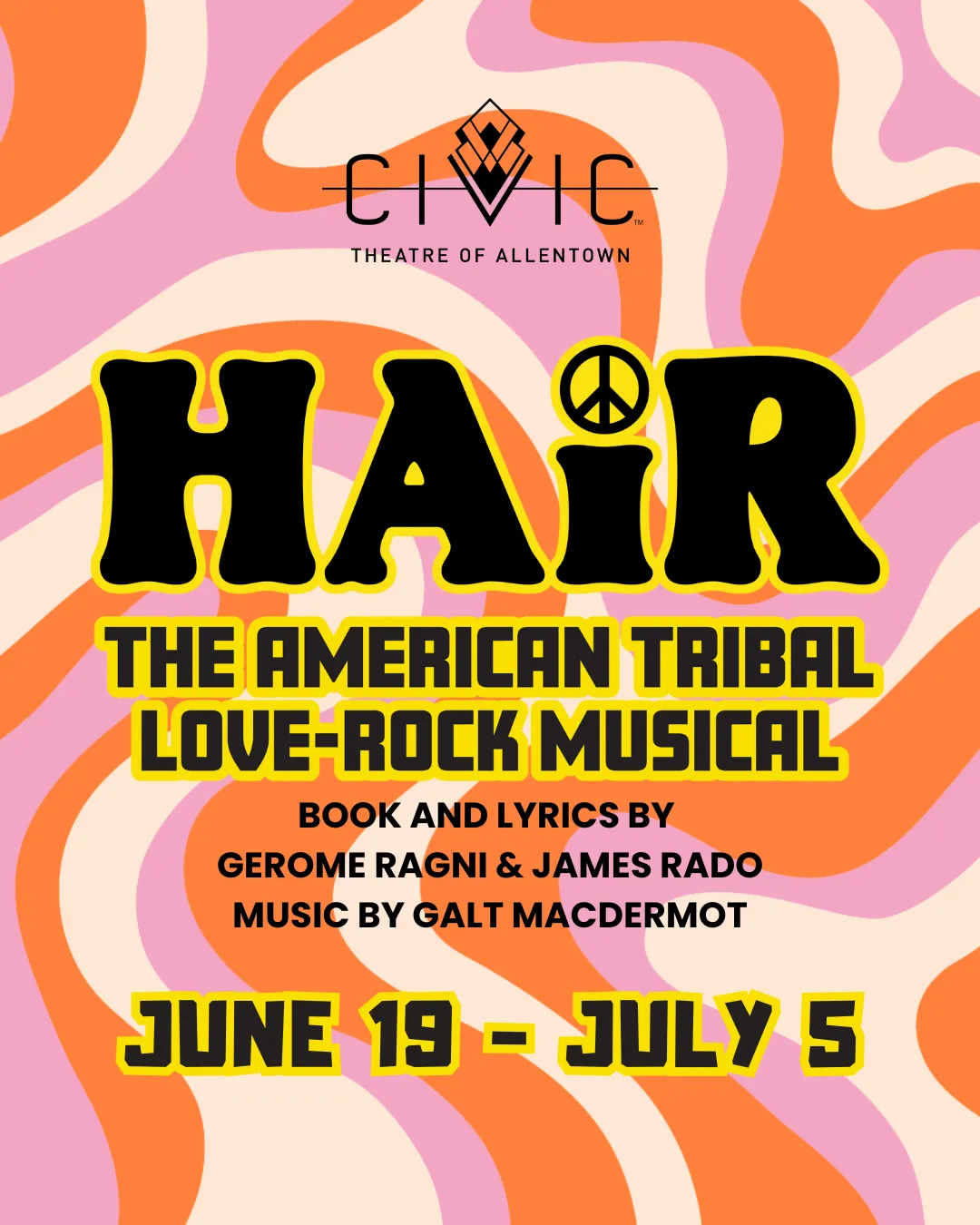
HAIR, written in 1968 by Gerome Ragni, James Rado, and Galt MacDermot, was among the first musicals to feature a rock and pop infused score and to usher in what became known as the concept musical. Rather than following a traditional plot, it unfolds through a series of episodes that illuminate its central theme: the human cost of war – specifically the Vietnam War. Because of this structure, the songs—often collages of ideas, words, and images—replace a traditional linear thought and plot. The lyrics work in concert to evoke the essence of an idea, which then flows into a scene or another musical number.
The loose narrative follows Claude, a young man facing the draft, as he wrestles with whether to embrace a free spirited life among a tribe of countercultural bohemians led by Berger or to enter military service. The musical takes Claude—and the audience—on a whirlwind journey through the sexual revolution, drug abuse, racial tension, political protest, and even moments of brief nudity.
The cast at the Civic Theatre of Allentown, under the musical direction of Steve Reisteter delivers the score’s highlights — “Aquarius,” “Let the Sunshine In,” and “Good Morning Starshine”— with energy and warmth, filling the theatre with a sense of communal joy that evokes the era’s blend of upheaval and hope.
But much of the vocal work elsewhere becomes muddled, with lyrics often rendered incomprehensible—whether because the tempos are too fast, the choreography (by Rose Fortkamp and Sarai Misic) competes with the actors’ ability to deliver the text, or simply due to careless articulation. This blurring of the lyrical clarity undercuts the impact of several musical moments and impedes the narrative development of the story.
Occasionally, the actors appear to struggle with the vocal ranges of their songs, often slipping out of intonation. A few bright spots do shine through: Makenna Copeland’s Dionne opens the production with a vibrant, full voiced “Aquarius,” and Melody Portnoy’s Chrissy offers a tender, heartfelt rendition of “Frank Mills.”
Anthony Rizzuto’s Berger establishes the character’s necessary anti-establishment irreverence but lacks the character’s magnetic swagger and commanding showmanship. Liam Thompson’s Claude emerges as a gentle, film loving dreamer facing uncertainty in the face of the looming weight of the draft. Rachel Kemmerer’s Jeannie glows with wide eyed idealism, grounding her pregnancy and earth mother aura in genuine warmth.
Josephine Genuardi’s set design creates an eclectic hippie enclave, using rolling stair units, platforms, and an array of found objects salvaged from the excesses of throw away materialism. Lighting designer Sarah Goldstein adds visual variety and sculptural dimension, shaping the space with nuance and energy. Rigby Maitico’s costumes capture the 1960s aesthetic with flair, grounding the production firmly in its era.
Director William Sanders’ production captures much of the show’s exuberant celebration of free will and anti establishment idealism. One might wish that Sanders’ production relied less on spectacle as mere shock value and instead pursued a deeper emotional core and higher dramatic stakes. Without this depth, the weaknesses in the book and story arcs become more apparent, and the production occasionally slips into feeling like a disjointed hippie revue.
Run continues thru July 5, 2026 at:
Civic Theatre of Allentown
527 N 19th Street
Allentown, PA 18104
Review submitted by:
Franklin Joseph
Author’s Bio:
Franklin Joseph is an avid theatre goer who takes delight in the active theatre arts community of the southeast Pennsylvania region.
