
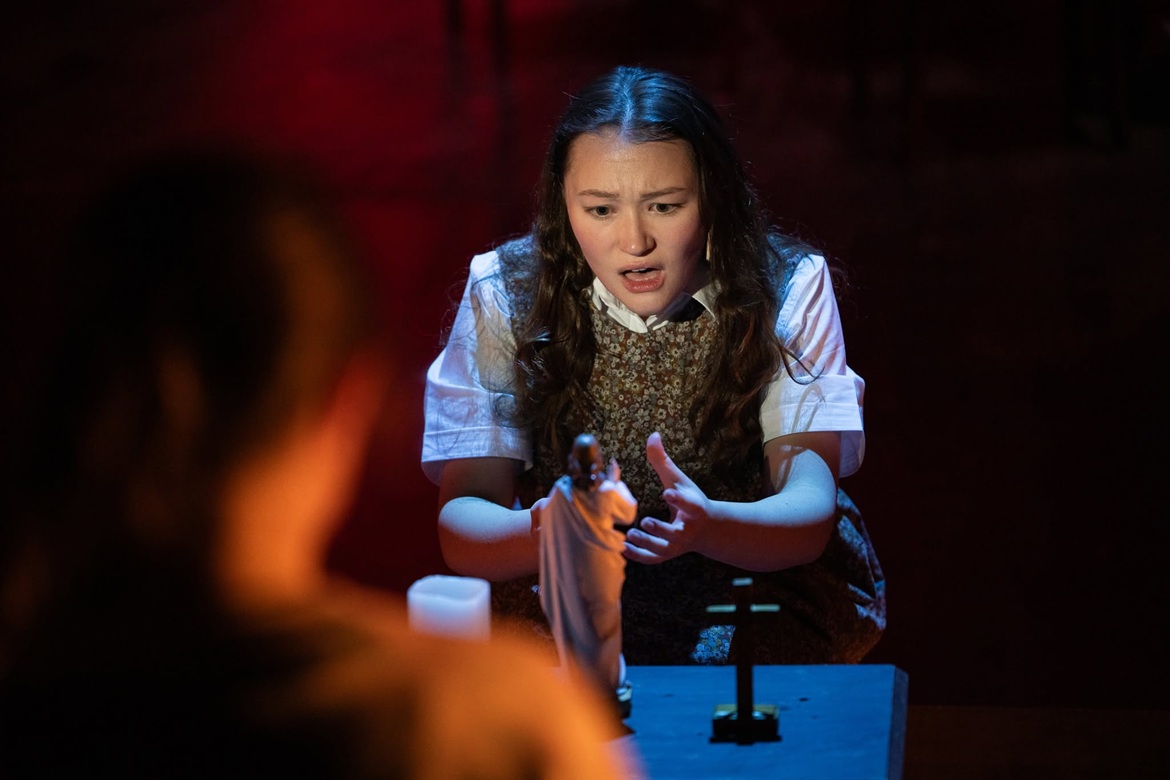
Muhlenberg College Stages a Thoughtful CARRIE
CARRIE, THE MUSICAL is one of the most notorious flops in Broadway history. Based on the novel by Stephen King and adapted by book writer Lawrence D. Cohen, composer Michael Gore, and lyricist Dean Pitchford, the production premiered on Broadway in 1988. It closed after 16 previews and just five regular performances, losing its entire $8 million investment.
As is often the case with high-profile flops, CARRIE developed a devoted cult following. It frequently appears in the autumn as Halloween fare, alongside a slew of productions of The Rocky Horror Picture Show, Little Shop of Horrors, and Sweeney Todd.
Under the direction of Jim Peck with musical direction by Julius Sarkozy and choreography by Lyndsey Vader, Muhlenberg College has produced a thoughtful production that strips away most of the cheap thrills for which the musical is renown, in favor of the raw weight of trauma. By converting the Empie Theatre’s standard proscenium stage into an industrial three-quarter thrust space, the scenic design by Jake Salgado infuses the production with a cold, yet intimate urgency.
Gore’s musical score is occasionally hampered by Pitchford’s clumsy, wordy lyrics, which frequently scan in unnatural rhythms and misplace syllabic emphasis. That said, the overall score is anchored by several powerful numbers that demand exceptional vocal and dramatic skill.
Abby Bera (Carrie White) and Amaya Romero (her mother, Margaret) navigated those demands with considerable success, forging sympathetic characters. Bera’s musical highlights included “Carrie” and “Why Not Me?” while Romero’s work on “When There’s No One”—the score’s most developed musical motif—was deeply affecting. Both actresses also fared well in the challenging “And Eve Was Weak.”
Additionally, strong supporting performances were delivered by Josephine Glass as Sue Snell and Seamus Brannigan as Tommy Ross. Both brought genuine humanity and a deep connection to their roles, singing with clarity and ease. Glass’s rendition of “Once You See” and Brannigan’s “Dreamer in Disguise” were standout moments.
However, a few production elements detracted from the overall quality. Relying on recorded tracks rather than live musicians occasionally left the singers out of sync with the audio, even under the baton of musical director Sarkozy. The sound design by Olivia Reiss resulted in buzzy vocal amplification projected from speakers high above the audience’s heads, which effectively disconnected the sound from the live action on stage. And scenic designer Salgado’s use of elevated side stages created frustrating sight line issues.
Director Jim Peck also chose a jarringly split approach to Carrie’s telekinesis. Early in the production, fellow actors physically moved objects to visualize Carrie’s awakening supernatural powers. Later on, however—such as when Carrie locks the windows in her home—scenic designer Salgado delivered one of the production’s most striking moments, utilizing automated design elements to slam the windows shut with spine-chilling force. The sharp disparity between these two staging conventions proved confounding.
Those issues aside, director Peck’s choice to position the audience so close to the action—practically within blood-splattering range—places us squarely on the hook, implicating us in the cruel marginalization of society’s outsiders.
Review submitted by:
Franklin Joseph
Author’s Bio:
Franklin Joseph is an avid theatre goer who takes delight in the active theatre arts community of the southeast Pennsylvania region.
