
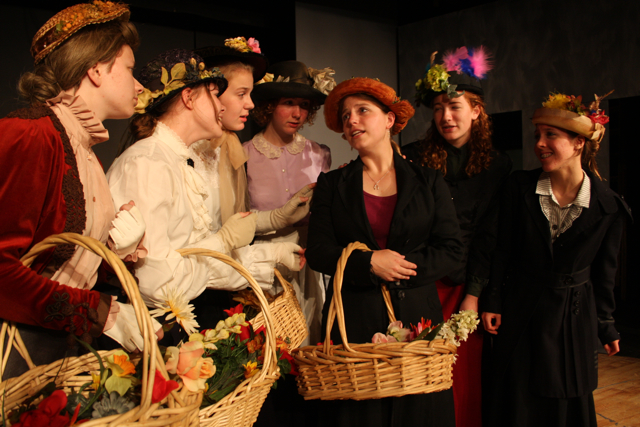
Now through June 26th, DCP Theatre presents Lerner and Loewe’s MY FAIR LADY.
MY FAIR LADY first opened on Broadway to rave reviews in 1956, closing six years later after 2,717 performances; a record run for a musical at that time. In 1957, it received ten Tony Award nominations, six of which resulted in wins, including Best Musical and Best Actor in a Musical (Rex Harrison). Through the years since, audiences have loved both the story and the wonderfully familiar songs from the show such as: “Wouldn’t it be Loverly”, “With a Little Bit of Luck”, “The Rain in Spain”, “On the Street Where You Live”, and “I’ve Grown Accustomed to her Face”.
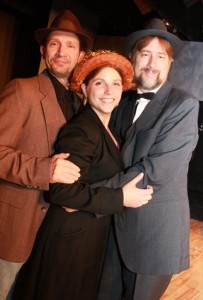
DCP’s production features really nice performances by the 10 cast principals and spirited scenes featuring the 23 supporting cast members. Particularly noteworthy is the energetic portrayal of Henry Higgins turned in by veteran DCP actor Mark Henry. He captures well the arrogant, self-assuredness of the role while also revealing at appropriate times glimmers of compassion for the feelings of others when chinks in his armor of intellectual superiority are exposed by his increasingly self-assured pupil, Eliza. His linguistic studies colleague, Colonel Pickering, is played by Barry Crush, who provides a convincing counterpart to Higgins’ haughtiness in his portrayal of a more gentleman-like representative of the upper classes. The title role is performed exceedingly well by Rebecca Shimer who sang Eliza’s songs beautifully and was always engaging in her transformation from an unrefined Cockney flower girl into a lady capable of passing herself off as a member of London’s upper social class.
Other noteworthy performances included Cindy Gerhart’s role as Henry Higgins’ aristocratic mother, who at first is repulsed by the idea of her son spending time with a low-class flower girl and who later befriends Eliza in deference to her superior quality of character when compared to that of her supercilious son. As Alfred Doolittle, Phil Cook, is suitable rowdy as Eliza’s pub-dwelling, devil-may-care father. Justin Walters plays the young Freddy Eynsford-Hill from the upper classes who first meets and falls in love with Eliza at the Ascot racetrack and later pursues her in his well-sung solo, “On the Street Where You Live”.
Special mention should also be made of the superb job in costuming this production. This is a very costume-rich musical with clothing ranging from lower-class working stiffs to aristocrats in ball gowns and tuxes with tails, and those responsible for getting all of this right for each scene deserve special mention for their contributions to this show: Costume Designer Alexis Leigh Ross and her team: Mary Boccella, Deb Takes, Deb Dawson, Abby Witwer, Camille Eustice, and Leah Stern.
Though the onstage performances by the actors, who obviously worked very hard to play their roles well, were praiseworthy, they seemed often in a struggle with the show’s terribly awkward staging which kept much of the action too far upstage. In all five key scenes taking place in Henry Higgins’ study, principal actors were forced to project significant parts of the story from the very back of the stage within a narrow raised platform setting that looked like a box diorama in which half of Higgins’ study was placed. The other half of the study was about four feet below and relatively center stage. Given this arrangement, actors were compelled to move between the two levels via four steps to accommodate the blocking of each scene. The fact that actors were often playing opposite each other while split between these two levels of the same set no doubt contributed to the frequent upstaging of actors in the lower half of the set who were addressing lines to counterparts still acting from the rear platform. I found this arrangement to be very distracting and seemingly unnecessary when those few set pieces relegated to the rear platform could have just as easily been incorporated into the rest of the center stage half allowing actors to play their parts forward and closer to the audience. Having the entire Higgins study scenes on the main stage level would have allowed the actors to make better use of downstage space bringing the impact of their lines and the story closer to the audience and could have contributed to better scene pacing as well.
In addition to a problematic set design and staging, this production of MY FAIR LADY was made less than fully satisfying by the musically-challenged accompaniment provided by the small orchestra sequestered on stage right somewhat behind grey partitioned flats. There were times when members of the orchestra seemed to be out of tune with each other and at other times the accompaniment just plain interfered with lines being spoken on stage. I understand the temptation to use a live orchestra, but I find in amateur productions that this tendency to want to try and replicate the full musical theatrical experience more often than not results in distractions rather than enhancements. In this case, I wondered throughout this three-hour production if the libretto would not have been better served by having the pianist as the sole instrumental accompaniment.
MY FAIR LADY
Book and Lyrics by Alan Jay Lerner
Music by Frederick Loewe
Directed by Raymond Thompson
June 3 – 26, 2011
dcp theatre
795 Ridge Road
Telford, PA 18969
215-234-0966
www.dcptheatre.com
